
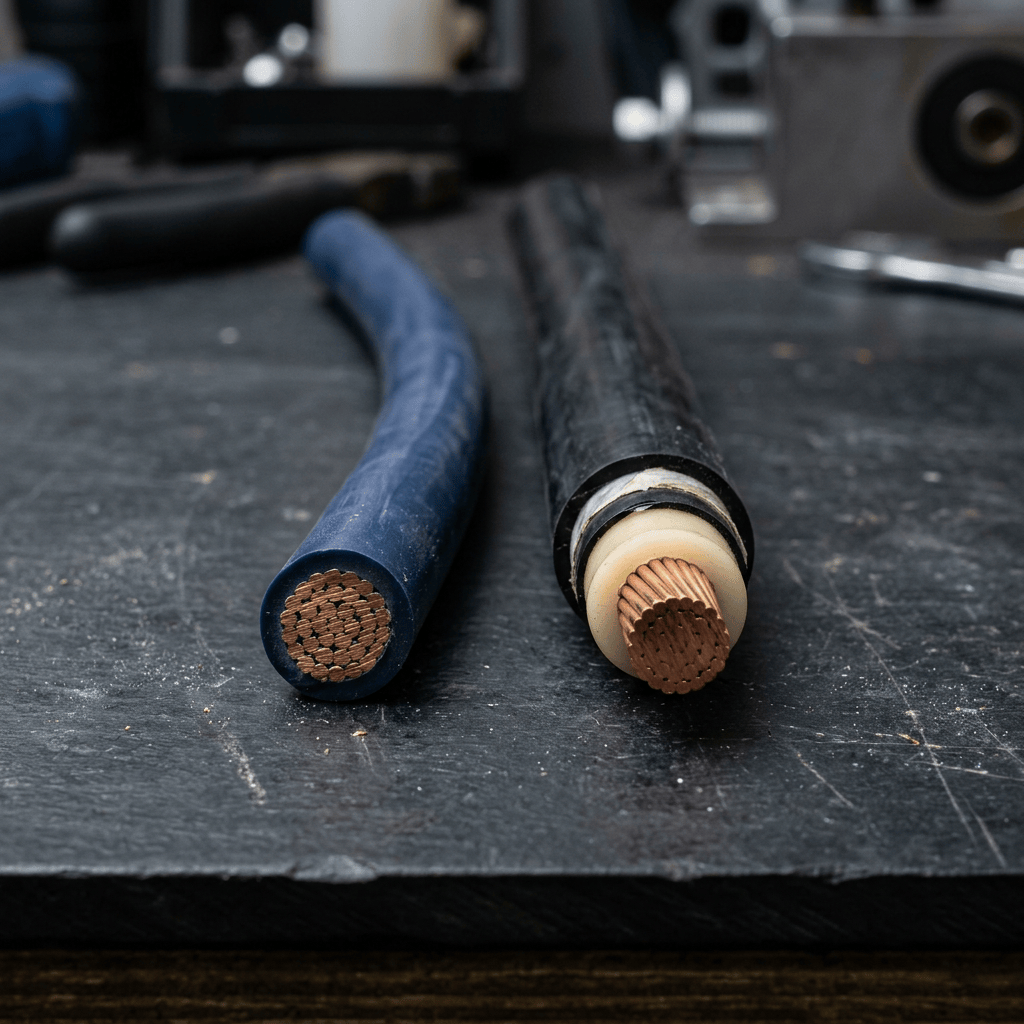
When comparing power cables, buyers often encounter descriptions such as “PVC insulated,” “XLPE insulated” and “XLPE/PVC.” These terms describe materials used in cable construction, but they do not always refer to the same layer.
Understanding the difference between insulation and sheathing is the first step towards reading a cable specification correctly.
Insulation and Sheath: Two Different Functions
Insulation surrounds the conductor and provides electrical separation from other conductors and surrounding conductive parts.
The outer sheath, also called a jacket, protects the cable assembly against external conditions. Its required properties depend on the installation environment.
A cable can therefore use XLPE insulation together with a PVC outer sheath. For example, an N1XV power cable uses precisely this combination. “XLPE/PVC” is not a contradiction: the two materials perform different functions in the same cable.
See this XLPE-insulated, PVC-sheathed cable example.
What Is PVC?
PVC stands for polyvinyl chloride. Conventional PVC cable compounds are thermoplastic materials, meaning they soften when sufficiently heated.
PVC is widely used for insulation, bedding and outer sheaths. Its formulation can be adjusted to provide different properties, making it a versatile and economical option for many cable applications.
However, “PVC” does not identify one universal performance level. Heat resistance, low-temperature behaviour, oil resistance and sunlight resistance depend on the particular compound and finished cable specification.
Further reading: PVC cable material properties.
What Is XLPE?
XLPE stands for cross-linked polyethylene. Cross-linking creates connections between polyethylene’s molecular chains, forming a thermoset structure.
This improves resistance to deformation at elevated temperatures while retaining useful electrical insulation properties. XLPE is widely used in power cable insulation across a range of voltage levels.
It is important to distinguish heat resistance from unlimited temperature tolerance. XLPE insulation still has defined operating limits, and excessive heat can damage it.
Further reading: XLPE insulation properties.
PVC vs XLPE: A Practical Comparison
| Feature | Conventional PVC insulation | XLPE insulation |
|---|---|---|
| Full name | Polyvinyl chloride | Cross-linked polyethylene |
| Material behaviour | Thermoplastic | Thermoset |
| Common uses | Building wiring, control cables and other low-voltage applications | Low-, medium- and high-voltage power cables |
| Typical conductor temperature rating in many standard power-cable applications | 70°C | 90°C |
| Main selection considerations | Required compound properties, application and cost | Thermal requirements, electrical performance and cable design |
The temperature figures above are common ratings, not universal limits for every PVC or XLPE cable. Special PVC compounds can have higher temperature ratings. Always use the applicable product standard and manufacturer’s data sheet.
The 70°C and 90°C figures refer to conductor operating temperatures—not the surrounding air temperature or the temperature at which installation is permitted. These are separate conditions.
Sources: PVC cable applications and EMSD technical guidance.
Does XLPE Automatically Allow a Smaller Cable?
No. A higher permitted conductor temperature can provide greater current-carrying capacity under suitable conditions, but insulation material alone does not determine the required conductor size.
Cable selection must also account for installation method, ambient temperature, grouping, voltage drop, short-circuit duty and the temperature limits of connected equipment.
Replacing a PVC-insulated cable with an XLPE-insulated cable is therefore not, by itself, sufficient justification for reducing the conductor cross-sectional area. The circuit must be assessed using the applicable design rules.
For an example of how insulation temperature limits affect short-circuit checks, see Schneider Electric’s Electrical Installation Guide.
Is an XLPE Cable Automatically LSZH?
No. “XLPE” identifies an insulation material; it does not establish the low-smoke, zero-halogen performance of the complete cable.
An XLPE-insulated cable with a PVC sheath contains a chlorine-bearing material and should not be described as a zero-halogen cable.
Where LSZH performance is required, specify the complete cable construction and the relevant smoke and halogen test requirements. Product specifications may reference the IEC 61034 series for smoke density and the IEC 60754 series for gases evolved during combustion.
An XLPE-insulated cable with an LSZH sheath illustrates how these requirements are stated separately.
What Should Buyers Include in an Enquiry?
Avoid requesting only “PVC cable” or “XLPE cable.” State which material is required for each layer.
For example:
“0.6/1 kV power cable with copper conductors, XLPE insulation and a PVC outer sheath.”
Then add the number of cores, conductor cross-sectional area, conductor class, armour requirements, applicable standard and installation conditions. Include any specific requirements for sunlight exposure, water, chemicals or fire performance.
The right choice depends on the complete cable and its operating environment. Clearly identifying the insulation and sheath materials helps suppliers prepare accurate quotations and makes different offers easier to compare.
For a project enquiry, contact Zhongde Wire & Cable at arvin@zhongdewirecable.com with your cable specifications and installation requirements.
